THE SCUTTLEBUTT
The Newsletter of the
USS Buchanan (DDG-14) Association
Spring, 2006
Vol VIII. No.
1 http://www.uss-buchanan-ddg14.org Editor: David B. Malone
For those who missed the reunion in Branson, Missouri this
year, I think I can speak for all who attended and say that you missed a great
time. As happened in Pensacola two years
ago, everything went off like clock work.
The hotel was great, the tours were great, the
banquet was excellent. Simply put,
everything was done right. Our hats go
off, once again, to Tim Nightingale who planned the reunion. Everything that was promised was delivered,
and as usual we got a little extra.
 We
had 36 attendees at this reunion. Some
of the same faces we’ve grown accustomed to seeing at all of our reunions, and
a few new ones added. Our hotel was the
Grand Plaza Hotel in Branson. As is
usually the case, when I arrived the hospitality room was in full swing. You could hear the party going on. It was very obvious where the hospitality
room was, even from the hotel’s front desk which was one floor below the
hospitality room’s mezzanine. A table
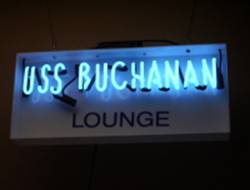
had been set up to check in shipmates, and above a beverage counter hung a neon
sign for “The Buchanan Lounge”, which had been donated by Phil Beinke. Everywhere
were shipmates reuniting. Some after a two absence
since the last reunion, and others for the first time since they had trod
non-skid decks.
We
had 36 attendees at this reunion. Some
of the same faces we’ve grown accustomed to seeing at all of our reunions, and
a few new ones added. Our hotel was the
Grand Plaza Hotel in Branson. As is
usually the case, when I arrived the hospitality room was in full swing. You could hear the party going on. It was very obvious where the hospitality
room was, even from the hotel’s front desk which was one floor below the
hospitality room’s mezzanine. A table
had been set up to check in shipmates, and above a beverage counter hung a neon
sign for “The Buchanan Lounge”, which had been donated by Phil Beinke. Everywhere
were shipmates reuniting. Some after a two absence
since the last reunion, and others for the first time since they had trod
non-skid decks.
Thursday was our first tour, which was a DUCK tour of
Branson. Aside from driving around the
“strip”, the tour took us out to Table Rock Lake where we did a bit of sea duty
together, and up a local hill from which we could see for miles. What most will remember of this tour was the
nearly constant barrage of bad jokes and puns that came from the driver. They were never ending. The afternoon was left to the individual to
explore the town on his and her own. A
number of us took a 20 mile train excursion that crossed the state line into
Arkansas.
For dinner that night, a number of us went to the restaurant
located on the top floor of the hotel.
It was the same restaurant we had breakfast in each morning. During the trip up, I noticed that the
elevator’s bulletin board was crowded with a great deal of baseball paraphernalia, all centered on a ball played named Jack
Hamilton. Most won’t know that name, but
I happened to come from Boston. “Jack
Hamilton!” I exclaimed. “That’s the pitcher who hit Tony Conigliaro in the head with a fast ball in 1967!” For those who don’t know that story, Conigliaro got popped in the head on his left cheek bone
with a 95 MPH fast ball. Fans at Fenway Park who sat in the bleachers claimed that they
could actually hear the impact. It
landed poor Tony in the hospital for months and, despite a brief comeback years
later, ended his career. A career in which he was the first player to hit 100 home runs
before age 21, and on track to Cooperstown. Tim Nightingale looked at me and said,
“Yeah...he owns the restaurant.” Sure
enough, it was Jack Hamilton himself who met us at the elevator and seated us
as the maitre de. I got the chance to
talk with him about that day in Fenway. I told him I knew it wasn’t his fault, and
that Tony always crowded the plate. His
batting helmet came off as he tried to get out of the way of the pitch, and the
ball just followed his head. I also knew
he tried to visit Tony in the hospital that night. I got Jack’s baseball card and his autograph,
shook his hand and continued my meal.
The food was pretty good too!
Friday included a trip to the Veterans Memorial Museum. This museum was a salute to veterans from WW
I to the present war in Iraq. Lots of
military gear and memorabilia abounded in the place, but a surprise was waiting
for us. As we turned a corner, we found
two elderly black men looking at a painting of a couple of mustang fighters
from WW II. These mustangs had red
tails, which was the fighter group marking for the famed “Tuskegee Airmen”, an
all-black fighter squadron in the US Army Air Force in WW II. We soon discovered that these two gentlemen
had been pilots in the Tuskegee Airmen.
Not only that, but one of the gentleman’s aircraft was identified on the
text panel as being the plane seen in the background. And he had no idea this painting was in the
museum or that it even existed! He and
his friend had simply walked into the museum as veterans, just like we
did. Meeting these two made our
day! We spent the rest of our time in
the museum with them as they told us of their exploits over Italy and
Germany. I think I can safely say that
meeting those two made the visit to the museum for many of us.
Saturday morning was our business meeting. The minutes from the meeting are in this
newsletter, so I won’t elaborate except that two significant things
happened. One, the membership adopted a
lifetime membership with dues of $140.00.
Also, our next reunion location was selected, after a debate over four
locations. The winning city is San
Diego, and it will be in February or March of 2008. And as is our standard procedure, Tim
Nightingale will plan the reunion. Also,
Tom Crosser gave the association a briefing on the plans to save the former USS
Charles F. Adams and bring her to St. Petersburg, FL. Tom and I are both members of the Adams Class
Veterans Association, which is undertaking this task. Those who would like to join or help should
contact Tom at Tecrosserbsausnr@aol.com
.
Saturday afternoon was an explore
on your own day. Personally, I visited
the Titanic Museum with Rob Browning and his wife Marian. It was quite good, containing 400 artifacts
from the Titanic. Speaking as someone
who works in the museum field, they did a wonderful job of telling the story of
Titanic, through hands-on exhibits as well as through artifacts.
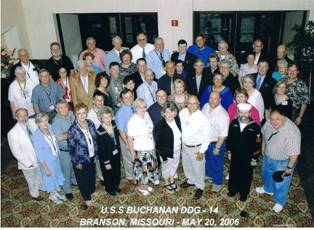 Our
Association Banquet was Saturday night, held in Jack’s restaurant in the
hotel. He was on hand to make sure we
were taken care of too. The food was
great, and the company was excellent.
Once again, as in San Diego, one of us squeezed into his dress blues and
wore them to the dinner. This time it
was Rob Browning, and he looked splendid.
After dinner there were prizes presented and a raffle drawing.
Our
Association Banquet was Saturday night, held in Jack’s restaurant in the
hotel. He was on hand to make sure we
were taken care of too. The food was
great, and the company was excellent.
Once again, as in San Diego, one of us squeezed into his dress blues and
wore them to the dinner. This time it
was Rob Browning, and he looked splendid.
After dinner there were prizes presented and a raffle drawing.
After the banquet it was
back to the hospitality room for more fellowship. More jokes shared, stories remembered. And, as it is always on Saturday night at
reunions, it was the end. The next day
we were all catching planes home. Back
to the lives we now lead.
TREASURER’S REPORT
PAID
MEMBERS (58)
Acosta, Javier; Andrew, Randy; Backer,
Bill; Baile, Bruce; Bartleson,
Don; Batterman, Bill; Beinke,
Phil; Borg, Gene; Boyle, Tim; Brinley, Bill;
Browning, Rob & Marian; Boyle, Tim; Bussey,
Robert Cabahug, Jaime; Casmier,
Dave; Clark, Jere; Connell, Dan; Crosser, Tom; Daisley, Dick; Doran, Paul; Egge,
Dennis; England, Carl; Falkenhan, Marc; Gant,
Charlie; George, David; Gilbert, Joe; Glidewell, Mel;
Gloyd, Elmer; Heffernan, Michael; Henley, Ron; Hubner, Leon; Kane, Ken; Kern, Tom; King, Michael; Kupec, Cole; Larsen, Jerry; Looney, Glenn; Malone, Dave; Marak, Ron; Martelly, Pete; Mezori, George; Myers, Dean; Nightingale, Tim; Norrod, Michael; Parks, Bill; Probus,
Ed; Proctor, Lou; Re, Joe; Ridley, Ray; Rudisill,
Terry; Sena, Pat; Sheridan, Tom; Smeltzer,
Steve; Snyder, Tom; Stroud, Mike; Taylor, Jim; Walla, Bob; Wihera,
Victor; Wood, Ken; Yarbrough, Dave; Zimmermann, Dick
NEW
MEMBERS SINCE JANUARY 2006
Bill Batterman SK3 1967 - 68
Joe Gilbert BTFA 1978 - 79
Elmer Gloyd SH3 1967 - 68
Bob Walla ETN2 1971 - 72
Bill Brinley RD2 1967 - 70
Charlie Gant PC1 1967 - 69
Joe Re 1964
- 66
Ron Henley SK3 1965 - 67
Bill Backer SK3 1970 - 73
Ken Wood RM2 1971 - 72
Leon Hubner SK3 1969 - 72
Paul Doran
TREASURER’S
REPORT
|
Balance
1 Feb 2006 |
$2,524.70 |
|
Dues |
826.00 |
|
Ship store sales |
583.70 |
|
Reunion raffle |
264.00 |
|
Ship store shipping |
- 32.05 |
|
Balance 31 May 2006 |
$4,166.35 |
BUSINESS MEETING MINUTES
Recorded by Marian Browning
The Business Meeting was called to order by
President Dave Malone at 10:00 am on Saturday, May 20, 2006. Members present were Phil Beinke,
Tim Nightingale, Charlie Gant, Dave Malone, Bill Backer, Bruce Baile, Bill Batterman, Ken Kane,
Ron Marak,
Robin Browning, Lou Proctor, David Yarbrough, Joe Re, Stephen Smeltzer, Mel Glidewell, Terry Rudisill, Bill Brinley, Ron
Henley, Grover Dan Connell, Bob Otis, Tom Crosser, Paul Doran, Ken Wood.
Tim Nightingale brought up the subject of locating crew
members. It was suggested that each
person identify as many people as possible from the cruise books and try to
find at least one person. Names should
be mailed to Tim to help with the search.
Dave Malone estimated that there are 4,000-5,000 over the lifetime of
the ship.
Mel Glidewell thanked Tim for
organizing a great reunion and appreciation from the membership was shown with
an enthusiastic round of applause.
Rob Browning announced that his wife, Marian Browning, was
in attendance as an associate member and that she would be taking minutes for
him but is a non-voting member.
New business included a discussion about a lifetime
membership. A number of organizations
were brought up and the amount of their lifetime dues. A motion was made to set the lifetime
membership cost at 10 times the current yearly dues ($140). The motion was seconded and unanimously
carried. A motion was also made to have
a membership card for both yearly and lifetime members. The motion was seconded and unanimously
carried. It was decided Dave Malone
would contact Dick Zimmerman and determine the best way to handle the mailing
out of the cards. Tim Nightingale
volunteered to make the cards.
The next order of new business was the location of the next
reunion in 2008. Dave Malone asked for
nominations from the floor stating that the bylaws indicate the reunion is to
be held on the West Coast. Seattle, San
Francisco, San Diego, and Las Vegas were suggested.
Marc Falkenhan arrived at the
meeting at 10:10.
Discussion ensued on what was in each town. Rob Browning stated things to do in San
Francisco. Tim reported that San Diego
was courting military reunions. It was
noted that the last San Diego reunion was in February and that the weather
would permit an off-season timeframe which would lower the expenses.
A poll was taken and a show of hands indicated that 2
members were in favor of Seattle, 8 in favor of San Francisco and 15 in favor
of San Diego. Tim Nightingale made a
motion to hold the 2008 reunion in San Diego.
The motion was seconded and unanimously carried. It was further decided that the timeframe
would be between February 15 and March 15.
The next order of business was the election of
officers. Mel Glidewell
made a motion to keep the current officers; Dave Malone, Dean Myers, Robin
Browning and Dick Zimmerman. The motion
was seconded and unanimously carried.
Other business included a discussion regarding recruiting
new members. Dave Malone said that there
needs to be a concentrated effort to recruit more officers and sailors who
served on the ship post-Vietnam era. It
was mentioned that we should advertise in the Navy Time, Academy News, State
VFW magazines, and the Navy League. It
was announced that the 2006 reunion was advertised in The Tin Can Sailor, VFW
Magazine, Sea Classics, and with The Fleet Reserve Association.
Robin Browning announced that a 1972 cruise book belonging
to Terry Rudisill was missing from the hospitality
room. He also stated that cruise books
are available on CD in the ship’s store.
He also stated that the polo shirts and windbreakers were not available
in the ship’s store but that a link to the provider should be posted on the web
site.
Tom Crosser gave a report regarding the activities of the
Adams Class Veterans Association that was formed three years ago to preserve
the last Adams class destroyer, the U.S.S. Adams DDG-2. He stated that the association was centering
their activities around relocating the ship to St.
Petersburg, Florida, at The Pier. The
efforts now are to gain the support of the mayor. Tom stated that the relocation to and refurbishment
of the Midway in San Diego took 11 years but was well received by the public
with over 900,000 touring the ship its first year of operation. He also stated that it would cost several
million dollars to make this happen.
Each Adams class destroyer has a representative at the Association and
the Buchanan representative is Dave Malone.
Tom also reported that the Adams has been on donation status for the
past 8 years and it would be decided on June 3rd whether to keep it
at this status for another year. Dave
announced that Tom would also make a short presentation to those in attendance
at the banquet scheduled for later that day.
Mel Glidewell requested a
timeframe for the banquet. Tim
Nightingale announced that the picture would be in the lobby at 5:30 and that
orders could be placed and the pictures would be delivered to the hospitality
room following the banquet. Following
the picture a cash bar would be available in the banquet room on the ninth
floor. Raffle tickets would be available
during this time. The dinner would be at
7:00 pm. It was decided that casual
dress was acceptable.
The meeting was
adjourned at 11:00 am.
NOW ON THE
BUCHANAN...
Moments in the life of USS Buchanan (DDG-14), taken from the ship’s
annual reports.
Forty years ago... 1966
In June
1966, BUCHANAN began her third
deployment to WESTPAC.
Thirty Five years ago... 1971
On 22 March, COMDESRON 15
broke his flag aboard BUCHANAN where it flew until 21 April. On 20 April
BUCHANAN set sail for Treasure Island and made a brief stop a Seal Beach
to unload ammunition before arriving in San Francisco on 22 April.
Thirty years ago... 1976
Almost totally recovered from her
shipyard experience, BUCHANAN got underway for local operations for 3-7
May. It was at this time that she tested the Tartar missile system. The results
were impressive: two direct hits on shore-launched drones. The successful
Tartar shot was a boon to the crew's morale and a tribute to the smooth
tactical performance/coordination exhibited by the Weapons and Operations
Departments.
Twenty Five years ago... 1981
The three weeks of the Ship to Shop
Availability (IS' Avail) assisted BUCHANAN in preparing for INSURV and
OPPE that were scheduled for April. ECC drills were conducted again in the SCOA
from March 30 until April 2. INSURV began upon returning to port on the 3rd in
conjunction with another IS' Availability. These two evolutions continued until
April 15 when BUCHANAN got underway for OPPE.
Fifteen years ago... 1991
On 11 February 1991, BUCHANAN saw her last underway period,
although it was only a dead stick move from pier One to pier Thirteen.
Nonetheless, the crew remained alert and positive as BUCHANAN was
underway for the last time. Many exercise and training evolutions took place
while the ship was in port. The crew's readiness levels grew as a direct result
of the various training evolutions. The month ended with a safety standdown in which one hundred percent participation was
achieved.
SEA STORY
OF THE QUARTER
Working
Party: E-6 and Below
By
Dean Myers 71-75
In the spring
of 1972 the NVA (North Vietnamese Army) started a major offensive across the
DMZ which was later named the “Easter Offensive.” Many stories have been told
and written of the events of the first two weeks. Among them are Bat 21, The
Rescue of Bat 21, The Bridge at Dong Ha, and The Easter Offensive.
This story
about working parties is one of many I remember.
I was a Junior
Third Class ET aboard the BUCHANAN. We were off the coast of Vietnam at the
DMZ when it started. Our NGFS (Naval Gun Fire Support) was in very high demand
because of heavy cloud cover that kept our aircraft from operating effectively.
Our NGFS was needed to neutralize the NVA’s armor,
artillery, and SAM (Surface to Air Missile) sites.
Our major
problem was being able to get enough ammunition to fire. One time the magazines
were completely empty and all we had left were the dummy rounds used for
testing the handling equipment – so we shot them. I am sure they did little damage, but hopefully
we made them duck. When we could go alongside an ammo ship we would take all we
could, topping off both magazines and leaving pallets out on the ASROC deck. We
would then fire missions until room was available in the magazines for the ammo
that was still topside.
That Westpac
we fired over 15,000 Rounds of NGFS and received over 1,000 rounds shot at us.
Between
calls for fire we would run to sea and grab what ammo we could. So the routine
was General Quarters, working party to handle ammo, couple hours sleep, and
back to G.Q. The SPA 25 Radar Repeaters started crapping out one at a time, so
for three days it was working parties, General Quarters, and fix a repeater. (I
blamed the recoil from the guns’ firing so much. We had cases where tubes shook
out of their sockets and fuses would fall out of the fuse holders).
The
number of hours sleep I had in three days could be
counted on one hand, with fingers left over. The port repeater on the bridge
had died just as we finished a strike at sunrise, and I started to repair it.
Soon
we were unrepping some ammo. Normally I would have to
wait till after Unrep but the OOD liked to use that
repeater on strikes, and I couldn’t work on it at night without screwing up the
watch’s night vision. Now we had been doing this for several weeks. At first
the working parties were E3 and below, then E4, then E5, as more people were
getting OK to continue their work, as unrepping was a
priority.
I
don't know if was because they actually needed us Junior
petty officers to keep the ship running or if we got better at making excuses
to stay clear of the working parties. I was told by my Division Officer John
Moore to work on the port repeater right through the unrep.
When they didn’t have enough people in the working party, it suddenly became
all E6 and below (I only saw that twice). When my first class Wayne Holden
heard he was to report to handle ammo, it occurred to him that I might need his
help to "fix" that SPA 25. I am sure if someone had pointed out that it
only took one ET to fix a repeater, I would have been the one sent to handle
ammo.
So
here we are, two ET's with the repeater open working
in the area between the repeater and the bridge windows. I had sat down on the
deck with my back propped on the bulkhead beside the Port Captains ( Commodores) chair reading a schematic across my lap. Then
Holden wanted to check something and took the schematic from me, and after
several minutes he realized something was not right because I had not moved in
all that time.
He
realized it had been at least 15 minutes since he had seen me move and that I
was sound asleep. So he put schematic back on my lap figuring that if no one
including himself had figured it out in 15 minutes, he would let me catch some
shut-eye. He was quite nervous because the CO and XO were within an arm’s reach
of both of us. Finally, when the Skipper stepped over my legs to cross the
bridge, Holden’s nerves could no longer take the strain and he woke me up.