

|
The Newsletter of the
|
|
September 9, 2000
Vol. II., No. 3
Editor: David B. Malone
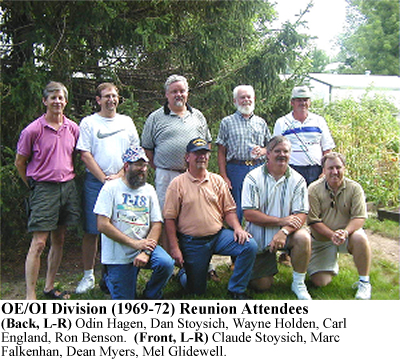
We've been gaining new members, and you will find a listing of them in this newsletter. And as usual, you will find a number of interesting articles in this newsletter. There is a listing of some additional pages that have been added to the web site. This includes a new web page for our new ship's store. We will use this ship's store to sell some of the things you used to be able to get in Buchanan's ship's store, as well as some new Buchanan items. You will find a report from a recent OE/OI division reunion in Omaha, along with a photograph of the attendees. There is the first part of a two part article about the development of the US Navy uniform. It provides answers to such questions as, "Why on earth did the enlisted uniform have bell bottoms?", and "What was that flap on the back of our jumpers for, anyway?" And, of course, their is the usual "Sea Story of the Quarter."
Plans are afoot for the next local Buchanan reunion, to occur in June of next year in Pensacola, FL, and there is some information about that in the newsletter. Plans are also being made for the next national reunion which will be held in late February, 2002 in San Diego. In regards to the San Diego reunion, Rob Browning is in touch with ML&RS. This is a company that will assist us in the planning of the reunion. They will do all of the organizing and make all of the contacts for us, and take a lot of weight off of our shoulders before and during the reunion. Shortly, members of the Buchanan Association will be receiving a questionnaire from ML&RS. This is for you to indicate what your preference will be for the reunion, such as how much you want to pay for a hotel room, what your wishes are for a banquet, what kind of tours and activities you would like to see offered, etc. Please fill this out and return it to ML&RS as soon as possible.
On a final note, we are now requiring a yearly dues of $14.00 for membership in the organization. Most have been on top of things and have sent the dues on to our treasurer along with a membership form. If you haven't done so yet, please take the time to fill out the form and send in your dues. If you need a membership application, please let me know at: malonedave@aol.com, or you can leave a message at (315) 568-2991 Ext. 29. I'll make sure that we get one to you. Saturday afternoon we met at Claude's house where we joined in on his son's graduation party. His son had just graduated from college with a BA in History. The "old folks", that's us, gathered in the backyard and were treated to some great mid-western, home style cooking of fried chicken, Stoysich sausage (my wife and I picked up $40 worth to take back to Denver with us), and a slew of side dishes, including that famous Nebraska corn on the cob. After everyone had eaten and had a few "cold ones", we chased the youngsters out of the air-conditioned house and gathered around the television set to watch the movies "Dino" Meyers had brought with him.
To warm us up, we first watched the movie, "Who Needs You Buchanan?", a movie made for the Navy in the mid-60's. It was a tale of how the Buchanan was able to save a downed pilot from the sea after he had to eject due to an emergency onboard his aircraft. This "jet jockey" got to see close up exactly "who REALLY needs you Buchanan". After that was the actual movies taken of the SINK-EX before the ex-BUCHANAN joined Davey Jones. It made us all proud to see how the "old girl" stood up to that barrage of firepower. It was during this showing that several of us developed colds or allergies because there sure was a lot of sniffling and wiping of eyes. The last movie was taken by a shipmate during the 1972 cruise showing leaving our homeport of San Diego, a few ports along the way, beautiful sunset shots from the fantail (remember those?) and actual combat scenes of both "out-going" and "incoming" rounds.
After the movies, more conversations and refreshments, the group split up with some going across the Missouri River, into Iowa, for a little gambling and others back to their hotel rooms to rest up before meeting back at the DAV. The big winner for the trip was Pam Glidewell (Mel's wife) who walked away with a little more than $1,000 in winnings for the trip. Prior to heading out for dinner, we were met by one more shipmate, Al Shaper (RD2), who could not meet with us Friday evening. After visiting awhile with Al, we headed off to Piccalo's Steak House and were treated to thick steaks, prime rib, or seafood. After the dinner we returned to the DAV for a nightcap and bid farewell to a few who were catching flights out in the morning.
For those of us who stayed on until Sunday, we were treated to a cookout at Dan
Stoysich's house. The beer served was compliments (leftovers) of the keg the
graduate and friends had left behind from the day before. Lunch was Dan's famous char-broiled burgers on the grill, more corn on the cob, potato salad, coleslaw, and delicious homemade peach cobbler or cherry pie. The highlight of the day was the "all hands" working party which mustered in Dan's front yard to load my Harley back onto my pickup. It seemed to go a bit smoother with six guys loading it than it was with only Carl England and my son at the start of the trip.
With the Harley safely loaded and strapped in, it was time to bid farewell. I'm sure I speak for everyone in extending a great big "Bravo Zulu" to Claude and Dan (and lets not forget their wives for putting up with us) for a great time and hospitality. It was sure great seeing everyone again.
Jim is busy makes plans for this reunion. For information, contact Jim at (850) 838-1623. Use authorization number 13 when asked for it.
REAL CHIEFS think Ensigns should be seen and not heard, and never, ever, be allowed to read books on leadership.
REAL CHIEFS don't have any civilian clothes.
REAL CHIEFS have CPO Association Cards from their last 5 commands.
REAL CHIEFS don't remember any time they weren't Chief's.
REAL CHIEFS propose like this "There will be a wedding at 1000 hours on 29 October, be there in whites with your gear packed because you will be a prime participant."
REAL CHIEFS favorite national holiday is CPO Initiation.
REAL CHIEFS keeps four sets of dress khaki uniforms in the closet in hopes they will come back.
REAL CHIEFS favorite food is shipboard SOS for breakfast.
REAL CHIEFS don't know how to tell civilian time.
REAL CHIEFS call each other "Chief."
REAL CHIEFS greatest fear is signing for property book items.
REAL CHIEFS dream in Navy Blue, White, Haze Gray and occasionally khaki.
REAL CHIEFS have served on ships that are now war memorials or tourist attractions.
REAL CHIEFS get tears in their eyes when the "Chief" dies in the movie "Operation Pacific."
REAL CHIEFS don't like Certified Navy Twill. "Wash Khaki" is the ONLY thing to make a uniform out of.
REAL CHIEFS can find their way to the CPO Club blindfolded, on 15 different Navy Bases.
REAL CHIEFS have pictures of ships in their wallets.
REAL CHIEFS don't own any pens that do not have "Property U.S. Govt" on them.
REAL CHIEFS don't voluntarily get the mandatory flu shots.
REAL CHIEFS don't order supplies, they swap for them.
REAL CHIEFS favorite quote is from the movie Ben Hur, "We keep you alive to serve this ship."
REAL CHIEFS think excessive modesty is their only fault.
REAL CHIEFS hate to write evaluations, except for their own.
REAL CHIEFS turn in a 4 page brag sheet for their evaluation.
REAL CHIEFS last ship was always better.
REAL CHIEFS know that the black tar in their coffee cup makes the coffee taste better.
REAL CHIEFS idea of heaven-Three good PO1's and a Division Officer who does what he is told.
REAL CHIEFS think John Wayne would have made a good Chief, if he had not gone soft and made Marine movies.
REAL CHIEFS use the term "Good Training" to describe any unpleasant task...Scraping the sides of the ship is "Good Training." Having to sleep on your seabag in the parking lot because there was no room in the barracks is "Good Training."
New Members The following are new members of the USS Buchanan (DDG-14) Association who have joined us since our last newsletter was published. I'm sure that you will join me in welcoming them all aboard. Tom Dowe, HTC, 1975-77Charles Gant, PC1, 1968-69 Paul Gardella, LT, 1978-82 Joe Giardina, EM2 1961-63 Mel Glidewell, RD2, 1966-70 J. Wayne Holden, EW1(ET), 1968-73 Chris Horsley, MR2, 1976-77 Randy Kirkpatrick, FTM1, 1967-71 Herb Kohnke, BT3, 1988-91 Jerry Nepper, ETN2, 1970-72 Terry Rudisill, OSC, 1969-72 Eric Sample, ETN3, 1967-68 Larry Schaefer, FTM2, 1969-73 James Taylor, GMGC, 973-78 David Wigent, STG2, 1961-65 Victor Wihera, RD2, 1964-65 Jahn Witzel, STG2, 1961-65
Most of you know about the efforts of the Saginaw Valley Naval Ship Museum Committee. They are trying to raise the money needed to bring the USS Charles F. Adams (DDG-2) to Bay City, MI to become a museum in the Saginaw Valley Ship Yard. This is important to us in the USS Buchanan (DDG-14) Association, and to other men who went to sea in Adams Class destroyers. If successful, this will be the only Adams Class DDG that doesn't get scrapped, sold to a foreign navy, become a power barge, or become a target as Buchanan did. In short, years from now when you want to show your grand kids the kind of ship that you served in, the saving of this one DDG now will be your only chance to do so. The Saginaw Valley Naval Ship Museum Committee needs your help. They are in dire need of funds. The museum's director, Mike Kegley, has grant funding lined up to bring the Charles F. Adams to Bay City. He needs matching funds, however, to utilize the money. Big business will not kick in donations unless he has big bucks in the bank. They know that if the project goes belly up they will lose their money, and so are taking a wait and see attitude. The committee is asking every sailor who served in any Adams Class DDG to send in $5.00. They need the funds to show businesses that there are other people out there behind this project. I think this is important. We may not all be able to get to Bay City and see the Charles F. Adams, but I think in future years a number of us will wish to visit her. Right now, we have approximately 100 members in the Buchanan Association. If every one of us sent in $5.00, that would make a total of about $500.00 from Buchanan sailors. There are 23 ships in the class, and a good number of them have associations. If half the ships in the class, say 11 ships, sent in an equivalent amount, that would make a grand total of $5,500.00. Not a whole lot of money, but perhaps a beginning. It just might be the primer needed to get businesses to start pumping donations into the project. If you can help, please send your donations to: SAGINAW VALLEY NAVAL SHIP MUSEUM COMMITTEE Make your checks payable to:Make your checks payable to: S.V.N.S.M. Remember, this may be our last chance to save one Adams Class DDG. Let's give them all the help we can muster.
You will notice that we now have a web page for departed ship mates. If you know of a shipmate who has passed on, please notify Dino (myersvac@penn.com, or at (724) 548-7335) and let him know about it. If at all possible, Dino would like to have their rate or rank, the years they served aboard Buchanan, and their death date. We also have a new web page for our Ship's Store. The ship's store is being run by Rob Browning, who is continually looking for new sources of things our members might wish to purchase. The Ship's Store has a two fold mission. One, it provides our members a source for many of the things we used to be able to purchase in the Ship's Store aboard Buchanan. We hope to soon have the very same coffee cups we used to buy aboard Buchanan, and hopefully the same ball caps. The second reason for the ship's store is that it provides a source of income for the treasury. Take a look at these new pages. The Final Mission
Those of you who know me are well aware of the fact that I have a great love of history, and in fact work in a job that requires a great deal of historical knowledge. This automatically makes me a candidate for one who believes in tradition. With that in mind, I found this information on the Great Lakes Naval Training Center web site. Part two will be published in the December newsletter. NAVY COLORS: 27 August 1802 the Secretary of the Navy signed an instruction which set a pattern for the dress of the U.S. Navy in Blue and Gold. UNIFORM REGULATIONS: The first uniform instruction for the U.S. Navy was issued by the Secretary of War on 24 August 1791. It provided a distinctive dress for the officers who would command the ships of the Federal Navy. The instruction did not include a uniform for the enlisted man, although there was a degree of uniformity. The usual dress of a seaman was made up of a short jacket, shirt, vest, long trousers, and a black low crowned hat. FOULED ANCHOR: The foul anchor as a naval insignia got its start as the seal of the Lord Howard of Effingham. He was the Lord Admiral of England at the time of the defeat of the Spanish Armada in 1588. During this period the personal seal of a great officer of state was adopted as the seal of his office. The fouled anchor still remains the official seal of the Lord High Admiral of Great Britain. When this office became part of the present Board of Admiralty, the seal was retained--on buttons, official seals, and cap badges. The Navy's adoption of this symbol and many other customs can be directly attributed to the influence of British Naval tradition. The fouled anchor is among them. KHAKI: originated in 1845 in India where British soldiers soaked white uniforms in mud, coffee, and curry powder to blend in with the landscape. Khakis made their debut in the U.S. Navy in 1912 when they were worn by naval aviators, and were adopted for submarines in 1931. In 1941 the Navy approved khakis for on- station wear by senior officers, and soon after Pearl Harbor chiefs and officers were authorized to wear khakis ashore on liberty. BROWN SHOES: In 1913 high laced shoes of tan leather first appeared in Uniform Regulations and were authorized for wear by aviators with khaki's. The color changed to russet brown in 1922. Uniforms exclusive to the aviation community were abolished in the 1920's and reinstated in the 1930's. The authorized color of aviators shoes has alternated between brown and black since then. PEACOAT: a cold weather version of the first uniform authorized-- the Pea-Jacket. A warm, heavy coat made from "Pee" cloth or "Pilot" cloth, a course stout kind of twilled blue cloth with a nap on one side. BELL BOTTOM TROUSERS: commonly believed that the trouser were introduced in 1817 to permit men to roll them above the knee when washing down the decks, and to make it easier to remove them in a hurry when forced to abandon ship or when washed overboard. The trousers may be used as a life preserver by knotting the legs. THIRTEEN BUTTONS ON TROUSERS: There is no relationship between the 13 buttons on the trousers and the 13 original colonies. Before 1894, the trousers had only seven buttons and in the early 1800's they had 15 buttons. It wasn't until the broadfall front was enlarged that the 13 buttons were added to the uniform and only then to add symmetry of design.
Sea Story of the Quarter Fog Watch Late in 1968 the USS Buchanan DDG14 was working on a special assignment to test out a new advanced missile tracking system for our on board missile threat tracking system. Every Monday morning we would put out to sea to spend most of the week testing this new advanced system. The crew quickly settled into a work routine not that much different than what we had on WestPac 68, with the exception that we didn't have all of the Sea Dragon operations. Where we kept having to go to battle stations every time the 1MC crackled the call, "Battle Stations, Battle Stations, all hands man your Battle Stations." All the while the General Quarters Bells were ringing. Thinking of the sound of those bells will still raise the hair on the back of my neck and makes the adrenaline flow. See the movie "In Harms Way" with John Wayne to see what I mean. However, on this day in late November, 1968, the USS Buchanan's 1MC and General Quarters bells were quiet. Instead we patrolled the waters off of San Diego and ran mock attack drills to see how our new missile tracking system was working. As many of you may remember, this time of the year off the coast of San Diego. The fog builds quickly, usually after sunset, and lingers till after sunrise. On the night in question, it had been decided by Ensign Allen that the ET's could share the fog watch with Boatswain Mates while the Buchanan prowled through the night, lurking and waiting for the dawn. Just before settling in for the night, the 1MC had crackled out its message, "Now set the fog watch." On this night I knew that I had the mid-watch and so I quickly settled into my bunk to try and grab a few winks before going on watch. The next thing I remember was the Boatswain Mate messenger coming around, trying to find the mid-watch relief for the next watch. He first tried ETRSN Dan Stoysich, next he went to ETR3 Champion only to find out these were the wrong guys. He misunderstood when Champion pointed to my bunk and so he dropped down and tried to wake up Wopie. His real name escapes me, but you couldn't wake Wopie up in the middle of a hurricane! Just then, I reached out and touched the messenger's shoulder causing him to jump with a startle. By this time he had figured out it was my turn to stand fog watch. Never having stood this watch before, I was not sure what to expect, but I got dressed quickly in my undress blues and grabbed my peacoat from its locker. We wore our undress blues because within minutes of taking your post the fog would have you soaking wet. At least the wool of the uniform held in some of your body heat. Someone, months before, had left his peacoat on board as they left the crew. The ET's had taken this coat to be the fog watch coat. I slowly made my way up the two ladders to the main deck and then exited through the starboard hatch onto the weather deck. Everything that I had been told about the fog watch was correct. It was like pea soup out there. You just about had to feel your way forward to the hatch in the weather break, and then onto the main deck next to the number one gun mount. I found the side railing and worked my way forward to my fog watch station. Just then the signal horn on the Buchanan started to blow with a defining roar. I was to find out that any ship underway in a fog had to sound a prolonged seven second blast at least once, every two minutes while underway. This first blast, however, just about caused me to jump overboard! My fog watch station was as far forward on the bow as a sailor could get, right up where they flew the Union Jack from a mast while we were at anchor. I met the ET that I was suppose to relieve and we quickly swapped peacoats. I remember that there were two men on this watch and the other guy's relief had not yet showed up. He handed me the sound powered headset that allowed us to talk to the Boatswain Mate of the watch on the Buchanan's bridge. As we plowed along at about five knots, you could hear the bow wave below us as the knife edge of the bow split through the water. Gradually my senses started to adjust to where I was. A voice crackled over the headset asking if the watch had been changed, and instructing us to listen for other fog horns, whistles or bells and report their relative positions. I quickly figured out that you wanted to turn down your white sailors cap so it covered your head the best it could. They were right, the fog was thick and very wet. As I sit here writing this story, I remember what it was like for Leonardo Dicaprio and Kate Winslet to have stood on the bow of the Titanic with reduced visibility on the darkened waters of the North Atlantic. As you may realize, this got to be a very trying job, with the horn blowing every two minutes and then listening for other fog horns. About a half hour into the watch we started to hear another fog horn and reported the sound's relative bearing to the bridge. It seemed that they were more interested in finding out if we were standing up at our post and not sitting on one of the capstans. The fog was so thick that the bridge watch couldn't see us or our position on the bow. It amused me that they kept calling on the sound powered phones to make sure that we were still with them. Where did they think we were going? We reported again the fog horn that we heard and with each report the watch communicator grew more agitated with us. Just then I heard the strangest sound. The sound seemed like someone blowing air off from an air compressor. I ask the other guy if he heard that noise. I started to report what we heard, which by then was much louder and seemed to be coming from more than one source. I felt the ship shutter and heard a terrible commotion below us. An urgent voice crackled on the headset, with all the excitement of James Cagney from the movie Mister Roberts, "What the hell was that?" Although I was barely able to see the surface of the water, I could see the white trashing of the water below. I heard the other man on watch say, "Oh, NO!", and then I realized that we had run into a whale. The poor creature must have been having a time of it, because the commotion in the water was horrendous. Just then, the ship's whistle blew. The collision must have really caused a commotion on the bridge. I reported that we had run into a whale and it was blocking our path. In fact, we had sailed into a pod of whales and they were all around us. In my mind, I could hear the sound of the engine telegraph ringing out "All Stop" and expected to hear the collision alarm any second. However the alarm never came and one of the bridge Quartermasters joined us quickly on the bow. We just sat there for several minutes while the whales swam on, waiting for our path to be cleared. To this day I can still remember the shuttering feeling of the bow as we plowed into that whale and all of the excitement that went along with it.
 |
|
Back to Buchanan Association Home Page
|
